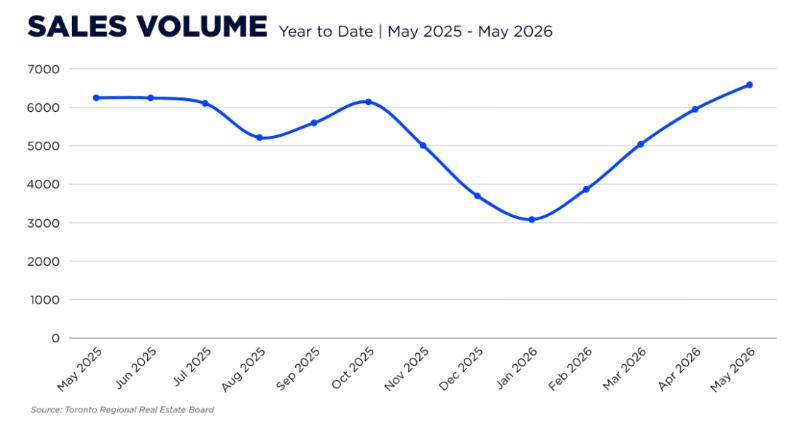
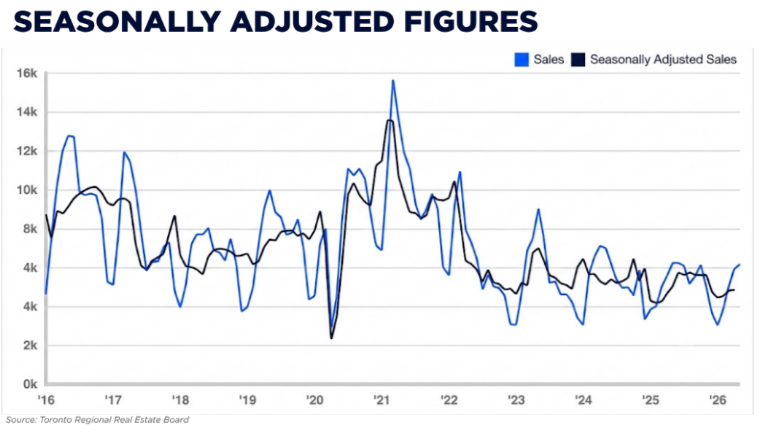
The Greater Toronto Area housing market continued its recovery in May 2026, with sales activity strengthening while new listings declined significantly. This combination of rising demand and shrinking supply is creating tighter market conditions and suggests the market has moved beyond the bottoming phase and entered the early stages of recovery.
After a weak start to the year in January, recovery momentum began to emerge in March and continued through April, when sales increased
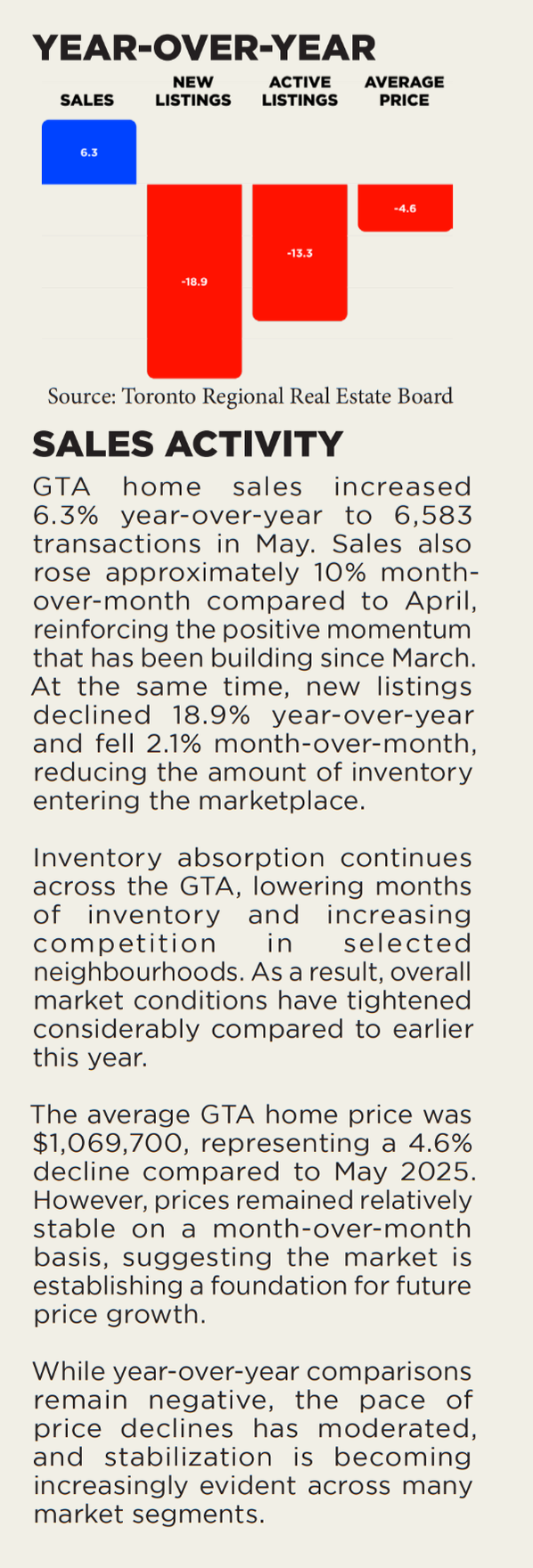
7% year-over-year. May built on that momentum, providing further evidence that market conditions are improving. The most important statistic this month is not the 6.3% year-over-year increase in sales. Rather, it is the combination of rising sales and an 18.9% decline in new listings. Historically, this type of supply-and-demand shift has been one of the earliest indicators of future price stabilization and eventual appreciation.
Freehold housing remains the strongest-performing segment of the market and continues to be the primary driver of the GTA’s recovery. Several factors are supporting the freehold sector:
- Move-up buyers are returning to the marketplace.
- Stable borrowing costs have improved affordability and consumer confidence.
- Supply of quality detached homes and townhouses remains limited.
- Competition is increasing in established neighbourhoods.
- Demand continues to outpace the availability of desirable freehold inventory.
Freehold transactions now account for approximately 58% of all GTA sales, highlighting the continued consumer preference for larger housing options.
Mature Toronto neighbourhoods continue to outperform many fringe and suburban markets. Areas with naturally constrained supply are experiencing stronger activity, shorter days on market, and increased buyer competition.
Historically, these neighbourhoods tend to lead housing market recoveries because inventory cannot be easily replenished, creating upward pressure on prices as demand returns.